
Why do tenements get damp? Search that question and most of what comes back talks about condensation. Cooking, showering, drying clothes indoors, poor ventilation. All real, all common, and all about moisture generated inside the flat.
But there's a second cause that gets far less attention, and it's the one that tends to cause the most expensive damage: water getting in from outside.
Penetrating damp, as it's properly known, isn't about lifestyle or ventilation. It's about defects in the building's external fabric.
The roof, the gutters, the stonework, that let rain in where it shouldn't be.
If you've ruled out condensation and the damp patch is still there, this is usually where the answer lies.
Why Do Tenements Get Damp: Condensation vs Penetrating Damp
Condensation damp tends to appear in predictable places. Corners, behind furniture, around windows, in bathrooms and kitchens. It's worse in winter when warm, moist air meets cold surfaces.
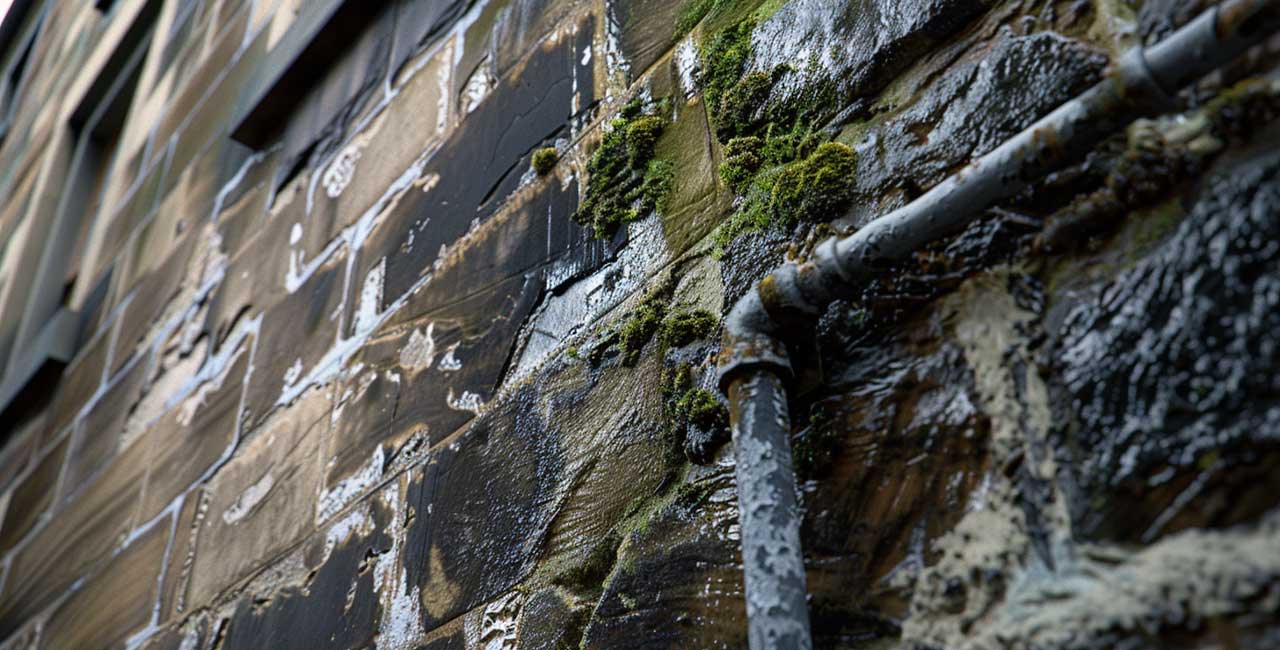
Penetrating damp behaves differently. It often appears as a stain with a defined edge, sometimes described as a tide mark, and it gets visibly worse after heavy rain or storms.
It can show up high on a wall, near a chimney breast, or along a ceiling close to an external wall. All signs that water is coming from somewhere outside the building and travelling in.
If your damp patch tracks the weather, the cause is almost certainly external.
The Roof: The Most Common Starting Point
Edinburgh tenements typically have slate roofs, and slate is durable but not indestructible. Slipped, cracked, or missing slates let water straight through to the roof void, where it can travel along timber and eventually show up as a stain on a ceiling several feet from where it actually entered.
Lead flashing is just as often the culprit. Flashing seals the joints where the roof meets a chimney, a parapet wall, or a dormer.
When it lifts, cracks, or simply ages out, it creates a direct path for water.
Because flashing failures are often small and hidden behind other roof elements, they can go unnoticed for a long time while quietly letting water in.
Ridge and verge mortar is another weak point. Once it starts to crack and fall away, wind-driven rain gets behind the ridge tiles and into the roof structure.
The frustrating part for many tenement owners is that none of this is visible without getting up close. A flat that's experiencing damp from a roof defect rarely has any way of knowing it from inside.


Blocked or Failed Gutters
Cast iron gutters are common on older Edinburgh tenements, and when they're working properly they carry rainwater away from the building entirely.
When they're blocked with debris, or the joints between sections have failed, water overflows and runs straight down the external wall instead.
That repeated saturation does two things. First, it accelerates erosion of the stonework and mortar joints, which can eventually let water through the wall itself.
Second, on a tenement with multiple floors, an overflow at roof level can run down past several flats before it ever reaches the ground. Meaning the flat with the damp patch isn't necessarily the flat with the gutter problem.
This is one of the more common findings when investigating damp in Edinburgh tenements: the source is several floors above the symptom.
Stonework and Pointing Failure
Sandstone, the material most Edinburgh tenements are built from, is naturally porous. It's designed to absorb and release moisture as part of how traditional buildings breathe.
But when the pointing between stones fails, or when stone has been repaired with the wrong type of mortar, that balance breaks down.
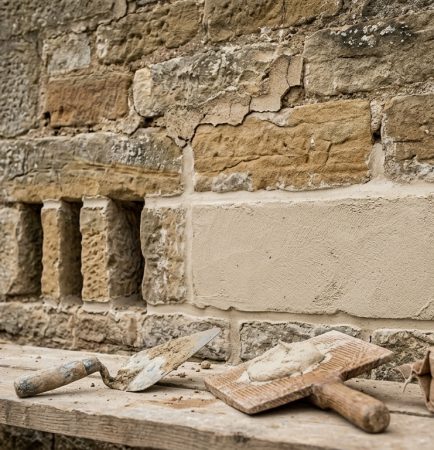
Cement-based repairs are a particular issue on older sandstone buildings. Cement is much less permeable than the lime mortar tenements were originally built with. It forces moisture to find another way through the wall, often making the problem worse rather than better.
Once wind-driven rain has a route in through open joints or degraded stone, penetrating damp on an internal wall is the result.
This kind of damage is rarely a single event. It builds slowly, over years of exposure, which is why it's so often missed until a damp patch finally appears inside.
Why This Gets Missed
The reason penetrating damp from external defects goes undiagnosed so often comes down to access.
Nobody can see the condition of a roof, a section of high-level guttering, or upper stonework from the ground.
A damp specialist working from inside the flat can identify that the damp is penetrating rather than condensation, but they can't tell you why without getting up to the source.
That's where the disconnect happens. Internal damp treatment without addressing the external cause tends not to last. The moisture finds the same way in again.
Getting to the Actual Cause
Identifying penetrating damp from outside requires getting close to the roof, the gutters, and the upper stonework
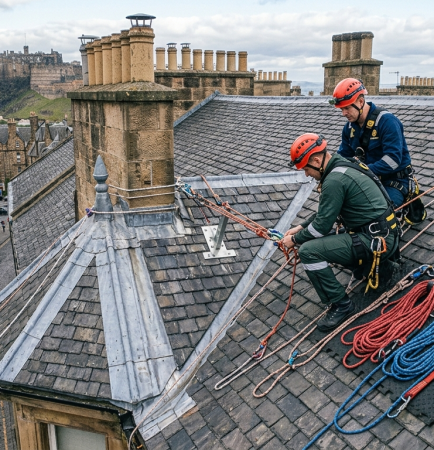
The same areas that are hardest to reach safely. This is where rope access becomes useful.
Rather than guessing from ground level or waiting for scaffolding, a technician can get directly to the roofline.
Inspect the slating, flashing, gutters, and stonework at close range, and identify exactly where water is getting in.
For a tenement, that's often the only practical way to find the real source of a damp problem rather than treating the symptom.
If you're dealing with damp that tracks the weather and doesn't respond to ventilation improvements, it's worth having the external fabric properly inspected before spending money on internal treatment alone.